
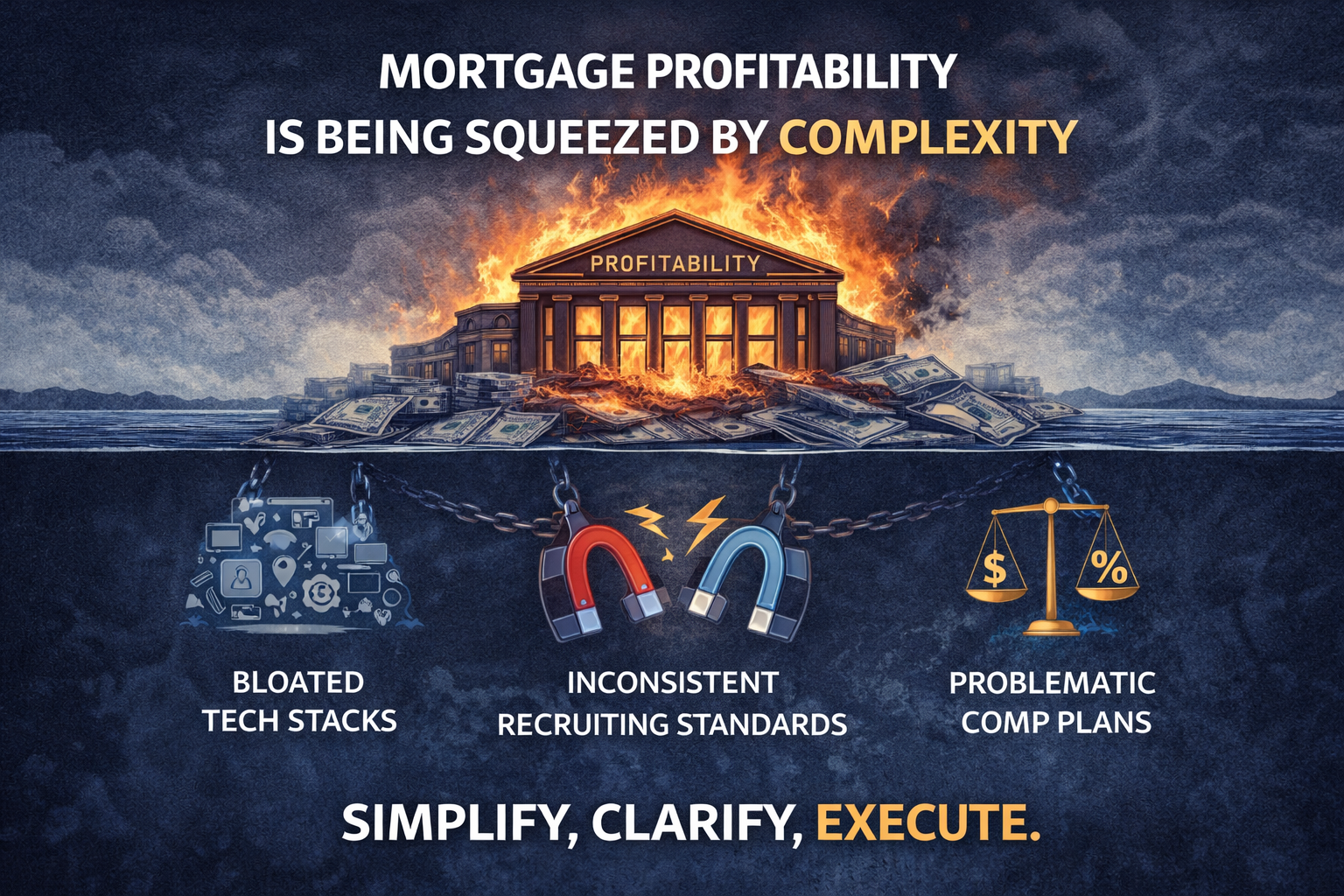
Mortgage Profitability Isn’t Being Squeezed by Rates Alone
The Hidden Complexity Problem in Today’s Mortgage Industry
Over the past two years, the mortgage industry has focused almost entirely on one culprit for declining profitability: interest rates.
Rates have certainly changed the landscape.
Transaction volume is down.
Margins are thinner.
Consumers are more cautious.
But after working with mortgage leaders across the country, I’m convinced something deeper is happening.
Mortgage profitability isn’t being squeezed by rates alone.
It’s being squeezed by complexity.
And many companies don’t even realize it.
The Complexity Problem No One Talks About
During the refinance boom, complexity was easy to hide.
Volume covered inefficiency.
Revenue masked operational friction.
Leadership teams didn’t feel the urgency to simplify.
But in today’s environment, those same structural problems are being exposed.
Three patterns show up consistently.
1. Bloated Tech Stacks
Over the past decade, mortgage companies have adopted technology at an incredible pace.
CRM platforms
POS systems
Marketing automation
Lead generation tools
AI tools
Sales enablement platforms
Recruiting platforms
Compliance platforms
Individually, many of these tools are excellent.
Collectively, they often create operational chaos.
Too many systems mean:
-
Duplicate workflows
-
Poor adoption
-
Confusing processes
-
Higher operating costs
-
Fragmented data
Instead of improving productivity, technology often adds layers of complexity that slow organizations down.
Technology should create clarity and leverage.
In many companies, it’s doing the opposite.
2. Inconsistent Recruiting Standards
Recruiting has always been a cornerstone of mortgage growth.
But in challenging markets, many companies abandon discipline in the name of survival.
Standards drop.
Instead of asking:
-
“Is this the right cultural fit?”
-
“Does this originator align with our long-term strategy?”
The question becomes:
“Can they close loans right now?”
Short-term recruiting decisions often create long-term cultural and operational problems.
When standards are inconsistent, companies experience:
-
Cultural erosion
-
Leadership frustration
-
Internal conflict
-
Lower accountability
Great companies recruit intentionally.
Struggling companies recruit reactively.
3. Compensation Plans That Reward Volume but Ignore Margin
One of the most overlooked drivers of profitability is how compensation is structured.
Many mortgage companies built compensation plans during years when volume was easy and margins were healthy.
Those structures often reward:
-
Units
-
Volume
-
Production totals
But they rarely reward profitability.
In today’s environment, that model becomes dangerous.
Without alignment between compensation and margin performance, organizations unintentionally incentivize behavior that reduces profitability.
Compensation plans should reinforce:
-
Margin discipline
-
Strategic growth
-
Sustainable production
If they don’t, leadership ends up fighting the very behaviors they created.
The Leadership Challenge
Hard markets don’t just test sales teams.
They test leadership.
The companies that will survive—and thrive—in the coming years will not simply cut expenses or wait for rates to improve.
They will do something much more difficult.
They will simplify.
That means:
-
Eliminating unnecessary technology
-
Clarifying recruiting standards
-
Aligning compensation with profitability
-
Creating operational clarity
Simplification requires courage.
It requires leaders willing to challenge assumptions, confront inefficiencies, and make decisions that create focus.
But the payoff is enormous.
The Path Forward
Mortgage companies that succeed in the next cycle will not necessarily be the largest.
They will be the most focused.
The most disciplined.
The most aligned.
And most importantly, they will be the organizations that choose to reduce complexity rather than add more of it.
Because in today’s market, complexity isn’t just inconvenient.
It’s expensive.
And the leaders who understand that will be the ones who build the next generation of great mortgage companies.